The Maine Coon guide · Kats Kits
Where Do Maine Coon Cats Come From?
Maine Coon cats come from the state of Maine and the rest of New England, in the northeastern United States. They are a natural breed, which means nobody designed them. They grew out of the region's farm, barn and ship cats over many generations, shaped by long winters and hard work, and by the 1800s they were a well-known local cat.
What nobody knows is exactly which cats started the line, or when. That gap has been filled with some of the best stories in the cat world. Here is what the evidence supports, which legends to set aside, and how a working farm cat became one of America's favorite pedigree breeds.
What Do We Actually Know About Where Maine Coons Came From?
Less than the stories suggest. There are no breeding records from the early days, because there was no breeding in the modern sense. These were working cats, kept to control rats and mice, and they chose their own mates. What can be said with confidence is this:
- They are domestic cats. Every Maine Coon is the same species as any other house cat, with no wild or exotic ancestor.
- They developed in New England. Maine is the breed's home, and big, shaggy coon cats were a familiar sight on the state's farms in the 1800s.
- Their ancestors probably came by sea. Ships carried cats to keep rodents out of food and cargo, and New England's ports saw ships from Britain, Scandinavia and the rest of Europe for centuries.
- The climate did much of the shaping. Cats that coped with deep snow and freezing winters lived to raise kittens. Heavy coats, tufted ears and paws, and big, sturdy bodies were the likely result.
That last point explains a lot about the breed today, including its size; see why Maine Coons are so big.
How Did Long-Haired Cats Reach New England?
Most likely on ships. The usual explanation is that long-haired cats arrived with sailors, traders and settlers, came ashore in Maine's port towns and bred with the short-haired cats already living there. In a cold place a long, heavy coat is a real advantage, so over generations it became normal among the local cats.
Where those long-haired cats came from is anyone's guess. Britain and the rest of western Europe are the likeliest sources, because most of the shipping came from there. An older idea points to Scandinavia: Norse explorers reached North America around the year 1000, and their ships may have carried the forerunners of the Norwegian Forest Cat. The two breeds do look alike, but there is no evidence that Viking cats survived in North America, and the idea remains possible but unproven. The guide to telling if a cat is a Maine Coon shows how the two breeds differ today.
Are Maine Coons Part Angora?
Possibly, a long way back, but nobody can show it. One of the most popular theories is that the long coat came from Angora cats, the long-haired cats of Turkey, carried to New England by seafarers in the 1700s or 1800s. Two things make the theory hard to prove or disprove:
- "Angora" was a loose word. In the 1800s, "Angora" and "Persian" were often used for almost any long-haired cat, so an old mention of an Angora says little about where a cat really came from.
- Nobody kept records. Farm cats were not registered, and their parentage was never written down.
What is clear is that a Maine Coon today is not a cross with the modern Turkish Angora. The Turkish Angora is a fine-boned, elegant cat with a silky single coat, very different from the big frame and heavy, shaggy coat of a Maine Coon. If Angora-type cats did contribute, they were one ingredient among many, long before anyone thought of the Maine Coon as a breed.
Is a Maine Coon Part Raccoon or Bobcat?
No, and no. These are the best-known legends about the breed, and both fall apart on the biology.
- The raccoon. The story goes that half-wild cats mated with raccoons in the Maine woods, producing kittens with bushy, ringed tails and brown, stripy coats. It cannot happen. Cats and raccoons belong to entirely separate families of mammals, and a raccoon is closer kin to a bear than to a cat. The two cannot produce young together.
- The bobcat. A similar story credits bobcats with the Maine Coon's ear tufts and size. Bobcats are wild cats of a different species, and nothing in the breed's history points to them. Ear tufts are simply a coat feature that plenty of ordinary long-haired cats share.
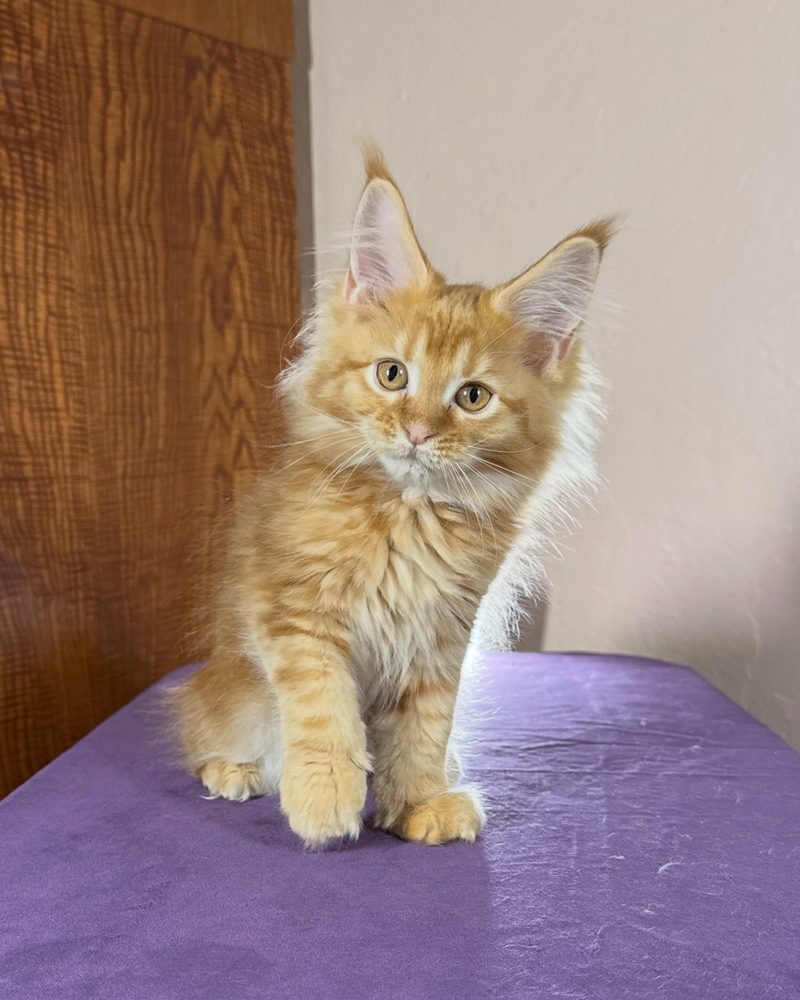
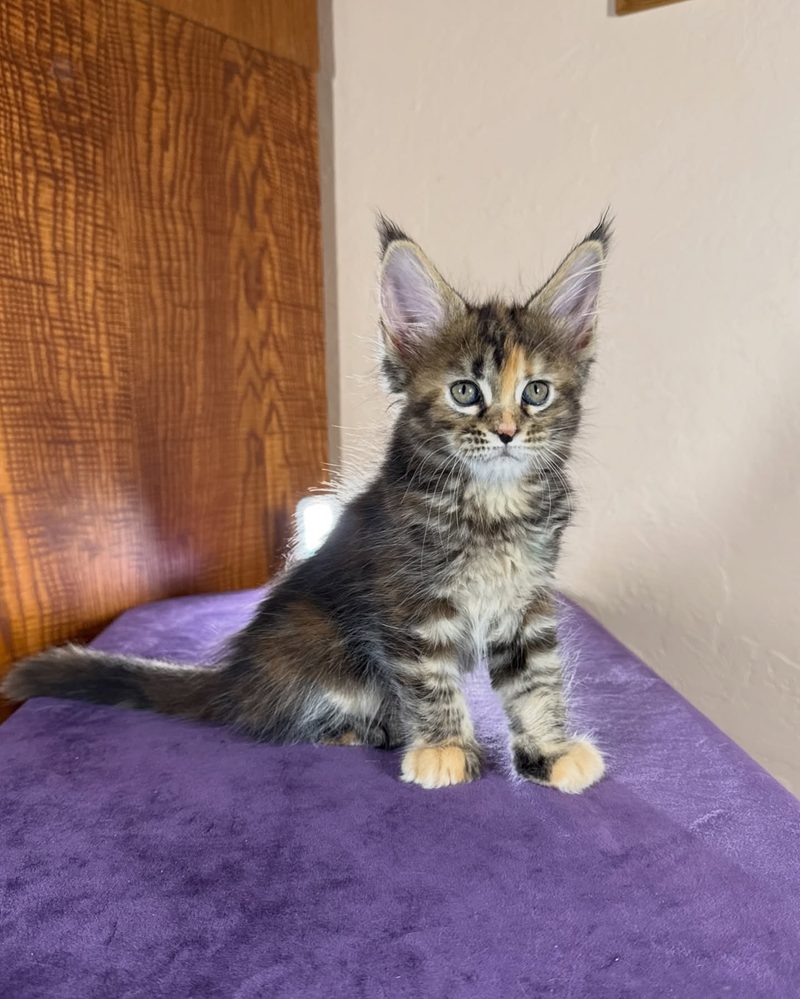
Why the legends lasted is easy to see. A big brown tabby with a thick, banded tail, sitting on a fence in the snow, does look a little like a raccoon, and the tufted ears do recall a bobcat. More on that look in what a Maine Coon looks like.
Did Marie Antoinette's Cats Become Maine Coons?
It is the most romantic of the origin stories. During the French Revolution, the story goes, a sea captain from Wiscasset, Maine, usually named as Samuel Clough, planned to carry Marie Antoinette to safety in America. She was executed in 1793 before she could escape, but her belongings, including her long-haired cats, had supposedly already been loaded onto his ship. The cats sailed to Maine, went ashore and founded the breed.
There is no evidence for any of it beyond the story itself. No record ties the queen's pets to Maine, and the tale reads like port-town folklore. It does fit the broader truth, though: long-haired cats from Europe, arriving by ship.
How Did the Maine Coon Get Its Name?
The "Maine" part is simple: the breed comes from Maine. The "Coon" part has two main explanations, and neither is proven:
- It looked like a raccoon. The likeliest answer. Many early coon cats were brown tabbies with bushy, ringed tails, and the name may simply describe that look. The raccoon-cross legend probably grew out of the name, or the name out of the legend.
- Captain Coon's cats. Another story names an English sea captain called Coon, who sailed the New England coast with a crew of long-haired cats. When long-haired kittens turned up in a port he had visited, locals called them Coon's cats. No trace of the captain or his cats has been found.
In Maine, people often just called them coon cats, and the fuller name stuck as the breed began to be shown. The brown tabby look behind it is still the classic Maine Coon, though the breed now comes in dozens of colors; see Maine Coon colors.
What Two Cats Make a Maine Coon?
None. A Maine Coon is not a cross between two breeds, and you cannot make one by mating, say, a Persian with a Norwegian Forest Cat. It is a natural breed: its type was fixed by generations of farm and ship cats breeding among themselves in New England, long before cat registries existed. Today a Maine Coon is a cat whose parents, grandparents and every recorded ancestor were registered Maine Coons.
That is why the word "mix" matters. A kitten with one Maine Coon parent and one ordinary cat is a Maine Coon mix, however much it looks the part, and only pedigree papers separate the two. For a wider introduction to the breed, see what a Maine Coon cat is.
When Were Maine Coons First Shown?
Long before formal cat shows, Maine farmers were comparing their coon cats at country fairs. Breed histories describe local contests in the second half of the 1800s, the fair at Skowhegan among them, to find the best coon cat in the state.
The breed's big moment came in 1895, at a cat show held at Madison Square Garden in New York, often described as the first major cat show in the United States. A brown tabby Maine Coon female named Cosey took the top award, a silver collar and medal. Maine Coons did well at the early American shows for some years afterward, and extra toes, common among New England cats, turned up often in those early cats. They still run in some lines; see polydactyl Maine Coons.
Why Did Maine Coons Nearly Disappear, and How Did They Come Back?
Fashion. Early in the 1900s, Persians and other imported long-haired breeds became the cats to own and to show, and the rugged farm cat from Maine looked plain beside them. Entries dwindled until, by the middle of the century, the breed had almost vanished from the show hall, and some people believed it was gone altogether.
It never was. Coon cats carried on as they always had, on farms and in kitchens across New England, and in the 1950s and 1960s a handful of breeders and clubs set out to keep them as a distinct breed, recording pedigrees and holding shows for them. Recognition followed:
- 1976: the Cat Fanciers' Association granted the Maine Coon championship status, so it could compete for titles at its shows.
- 1985: Maine named the Maine Coon its official state cat.
Where Are Maine Coons Bred Today?
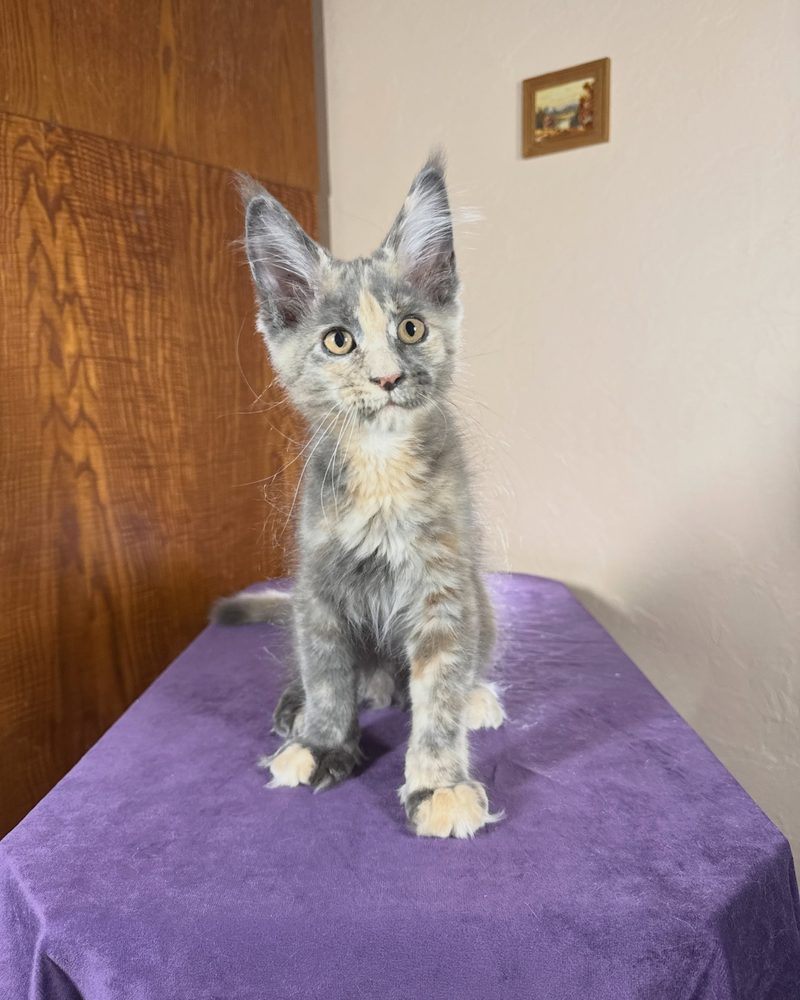
All over the world. The regional farm cat is now one of the most popular pedigree breeds in the United States and a favorite across Europe and beyond, recognized by every major registry, including the CFA, TICA and ACFA. Some lines, often sold as European Maine Coons, are bred for a more dramatic look, with taller ears, heavier tufts and a more angular head. They are still the same breed.
Many breeders are still small, home-based catteries. Kats Kits is one: Kat Doring has raised Maine Coons at her home in Farmington, Minnesota, since the mid-2000s, and is listed with the American Cat Fanciers Association; read more about Kats Kits. A Maine Coon kitten from Kats Kits is $700, and the kittens ready for new homes are on the available kittens page.
Quick Answers
Are Maine Coons part lynx?
No. Lynxes are wild cats, and the Maine Coon is a domestic cat with no wild ancestry. The tufts on its ears, called lynx tips, are named for the resemblance, not for any relationship.
How old is the Maine Coon breed?
Older than any record of it. Coon cats were well established in Maine by the 1800s, which makes the breed one of the oldest native to North America, though its exact starting point is unknown.
Were Maine Coons ship cats?
Their ancestors very likely were. Ships carried cats to keep rats away from food and cargo, and some of those cats came ashore in New England ports and stayed.
When did the Maine Coon become an official breed?
Maine Coons were shown from the late 1800s, but the modern milestone came in 1976, when the Cat Fanciers' Association granted the breed championship status. All the major registries recognize it today.
Why is the Maine Coon the official cat of Maine?
Because the breed developed there, as the state's own farm and working cat. Maine made it the official state cat in 1985.