The Maine Coon guide · Kats Kits
How Big Do Maine Coon Cats Get?
Big, and slowly. A grown male Maine Coon usually weighs 13 to 18 pounds and a female 8 to 12 pounds, and many measure 30 to 40 inches from nose to tail tip. That makes the Maine Coon one of the largest domestic cat breeds, but the size takes years to arrive: Maine Coons keep growing until they are 3 to 5 years old.
The figures below show how large and how heavy Maine Coon cats usually get. They are typical ranges, not targets: individual cats vary, and a healthy Maine Coon at the low end of the range is still a healthy Maine Coon. If you are new to the breed, start with what a Maine Coon is.
How Much Does a Maine Coon Cat Weigh?
Most grown Maine Coons fall within these ranges:
| Measure | Typical grown Maine Coon |
|---|---|
| Weight, males | 13 to 18 lb |
| Weight, females | 8 to 12 lb |
| Length, nose to tail tip | 30 to 40 inches |
| Height at the shoulder | Roughly 10 to 16 inches |
| Age when fully grown | 3 to 5 years |
For comparison, a typical domestic cat weighs somewhere around 8 to 10 pounds, so a big male Maine Coon can be close to twice that. Some of what you see is coat, though. Under the fur, a Maine Coon is long, muscular and heavy-boned rather than round.
A few lean males go past 20 pounds, usually tall, long cats from big lines. Many cats described as 25 or 30 pounds, though, are carrying fat rather than frame.
How Big Is a Maine Coon at Each Age?
| Age | Typical weight | What is happening |
|---|---|---|
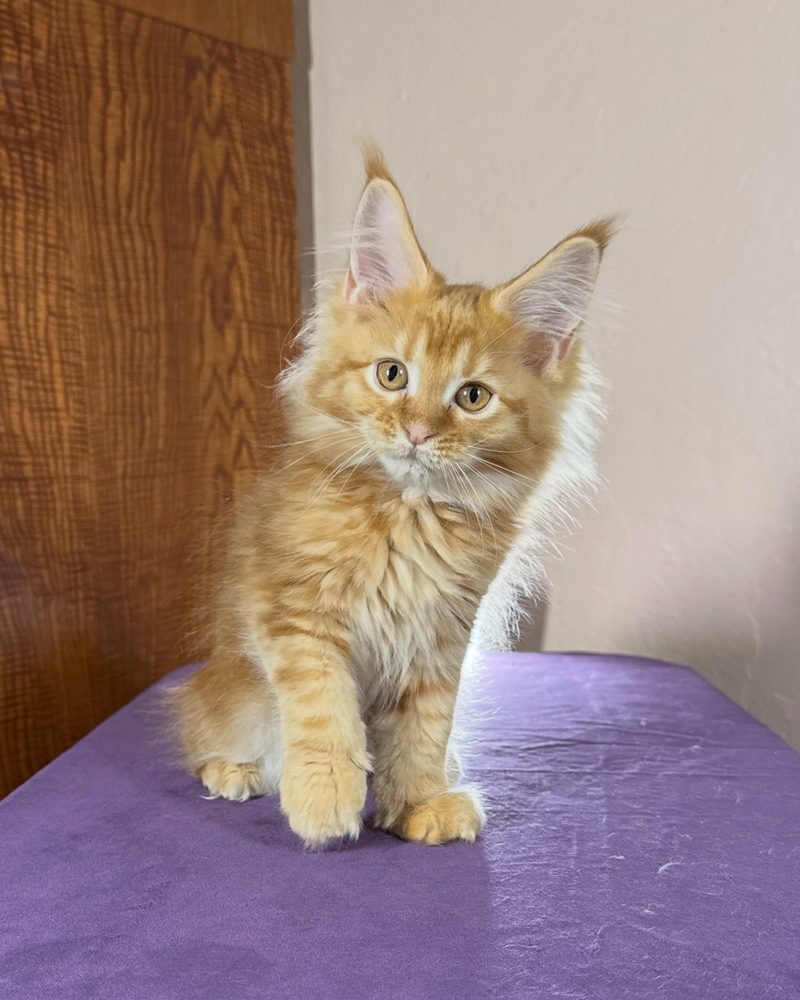
| 10 weeks | 2 to 4 lb | Much the size of any kitten, but with big paws, big ears and a long tail. |
| 6 months | 7 to 11 lb | Fast growth: long legs, a lanky body and a big appetite. |
| 1 year | 9 to 15 lb | Close to adult height, but still narrow and light for the frame. |
| 2 years | Roughly 8 to 12 lb for females, 12 to 17 lb for males | Filling out, with a broader chest, more muscle and a fuller coat. |
| 3 to 5 years | 8 to 12 lb for females, 13 to 18 lb for males | Fully grown, with the heavy ruff and full tail of an adult. |
Weigh your kitten every few weeks during its first year. Steady gain matters far more than hitting a particular number, and a kitten at the low end of a range is not a problem if it keeps growing. For what changes month by month, see Maine Coon kitten growth stages. Kats Kits kittens go home at 10 weeks, and you can see the current ones on the available kittens page.
When Do Maine Coons Stop Growing?
Usually between 3 and 5 years old, which is late for a cat: most cats are close to full size at around a year. A Maine Coon does most of its growing in length and height in its first year or so, then spends the next few years filling out, adding muscle, bone and coat. Males often keep developing for longer than females.
This slow growth is why a 1-year-old Maine Coon can look leggy and slim, and why it is too early to judge a young cat's final size. It also means Maine Coons stay playful and kitten-like for longer than many breeds; see Maine Coon personality.
Are Male Maine Coons Bigger Than Females?
Yes, noticeably. Males usually weigh 13 to 18 pounds and females 8 to 12, so a grown male is often half as heavy again as a female, or more. Males also tend to have broader heads, heavier bone and a bigger ruff.
A female Maine Coon is still a substantial cat by ordinary standards, often as big as or bigger than an average house cat, and her more compact size suits some homes better. If size matters to you, a male is the safer bet; if it does not, choose on personality.
What Is the Biggest Maine Coon on Record?
A Maine Coon named Stewie was recognized by Guinness World Records in 2010 as the longest domestic cat, measuring 48.5 inches from the tip of his nose to the tip of his tail. That is well beyond the 30 to 40 inches of a typical Maine Coon, and Stewie was an exceptional cat, not a model for what to expect.
There is no record for the heaviest cat to aim for. Guinness World Records no longer accepts records for the heaviest pet, so as not to encourage owners to overfeed their animals, which is a good principle for every Maine Coon owner to keep in mind.
What Affects How Big a Maine Coon Gets?
Why the breed is so large in the first place is covered in why Maine Coons are so big. How big one particular cat grows comes down to these:
- Genetics. The biggest factor. A kitten from large parents is likely to be large, and one from smaller parents smaller. Ask the breeder about the parents, but be cautious of any promise of an exact adult weight.
- Sex. Males grow larger than females.
- Nutrition. A kitten needs a good, high-protein kitten food through its first year to reach its natural size. Good food lets a cat reach its genetic potential; extra food does not take it beyond that, it just adds fat. See what Maine Coons eat.
- Neutering. Sex hormones help close the growth plates in the bones, so neutering before they close can delay that slightly, and some people believe this makes a small difference to the adult frame. Any difference is modest. The larger effect is that a neutered cat needs fewer calories, so portions may need trimming afterward. Your vet can advise on timing.
- Health. Parasites or illness in kittenhood can hold growth back, which is one reason early vet care matters.
Are Giant Maine Coons Real?
Be careful with ads for "giant", "XL" or "XXL" Maine Coons, or kittens promised to reach 25 or 30 pounds. No breeder can guarantee a kitten's adult size, and photos are easy to stage: a cat held close to the camera, or beside a small person, looks enormous. A healthy Maine Coon from a big line can be impressive, but giant is not a separate type of Maine Coon, and the breed standards ask for a balanced, well-proportioned cat rather than sheer weight. Size alone does not make a cat a Maine Coon either; see how to tell if your cat is a Maine Coon.
The bigger worry is what chasing size does to a cat. Some owners feed extra in the hope of a record-breaking Maine Coon. The result is not a bigger frame but a fat cat, with a higher risk of diabetes and joint trouble, which matters in a breed already prone to hip dysplasia. Feed for a lean cat, not a heavy one.
How Can You Tell if a Maine Coon Is Overweight?
The coat makes it hard to judge by eye, so use your hands:
- Ribs. Run your hands along the sides. You should be able to feel the ribs under a thin layer of fat with light pressure. If you have to press to find them, the cat is carrying extra weight.
- Waist. Looking down from above, with the fur smoothed flat, there should be a slight inward curve behind the ribs.
- Belly. Many cats have a loose flap of skin low on the belly, called the primordial pouch, that swings when they walk. That is normal. A round, firm belly is not.
- Trend. Weigh your cat every month or two. Weight that keeps climbing after the frame has stopped growing, or a cat that gets wider without getting longer, points to fat rather than growth.
If you are unsure, ask your vet to score your cat's body condition at the next checkup and suggest a target weight. A lean Maine Coon is also a longer-lived one; see Maine Coon lifespan.
How Much Space Does a Maine Coon Need?
A Maine Coon does fine in a house or an apartment, but its equipment needs to be sized for a big cat:
- Litter box. Extra large, ideally at least one and a half times the cat's body length, with high sides. Many owners use a large storage tote with an entrance cut in one side.
- Cat tree. Tall, heavy and broad based, with wide platforms. A light tree that wobbles under a 15 pound cat will be ignored, or will fall over.
- Scratching post. Tall and heavy enough that a grown Maine Coon can stretch fully upright without tipping it.
- Carrier. A large hard-sided carrier for an adult. The one that fits a 10 week old kitten will not last.
- Bowls and bed. Wide, shallow bowls and a bed big enough to stretch out in.
Most of all, a big cat needs vertical space: shelves, window perches and a tree it can climb to watch the room from up high. The bigger kit costs a little more, which is covered in how much a Maine Coon costs.
Quick Answers
How big can a Maine Coon cat get?
Most grown males stay within 13 to 18 pounds and 30 to 40 inches from nose to tail tip. A few lean males are larger, and the Guinness record for the longest domestic cat, 48.5 inches, belonged to a Maine Coon named Stewie.
How big is a 1-year-old Maine Coon?
Usually 9 to 15 pounds. A year-old Maine Coon is close to its adult height but will keep filling out for another two to four years.
Is a 20 pound Maine Coon normal?
It can be for a tall, heavy-boned male, but many cats at that weight are overweight. Check the ribs and waist, and ask your vet.
How tall is a Maine Coon?
Roughly 10 to 16 inches at the shoulder when fully grown, with males usually at the upper end.
Can Maine Coons be small?
Yes, for a Maine Coon. Females usually reach only 8 to 12 pounds, about the size of an ordinary house cat, and cats from smaller parents can stay at the low end of the range all their lives.
Why is my Maine Coon so small?
Often because it is young, female or from smaller parents: Maine Coons fill out until 3 to 5 years old, and genetics set the frame. Poor nutrition or illness in kittenhood can hold growth back, and a cat without papers may be a mix rather than a purebred. If a kitten stops gaining weight or its growth seems poor, ask your vet.
Can I tell how big my kitten will be?
Not exactly. The size of the parents is the best guide, and a kitten with big paws and a long frame often makes a big cat, but no one can promise an adult weight.