The Maine Coon guide · Kats Kits
How to Tell If Your Cat Is a Maine Coon
Big, fluffy and with tufted ears, a lot of cats look like Maine Coons. Some are. Many are domestic long-haired cats with no Maine Coon ancestry at all, and some are somewhere in between. Looks can point you in the right direction, but they cannot settle the question.
So how do you know if your cat is a Maine Coon? Here are the signs to look for, a checklist to run through with your own cat or kitten, how the Maine Coon differs from the breeds it is most often confused with, and what "Maine Coon mix" really means.
How Do I Know If My Cat Is a Maine Coon for Sure?
Not just by looking. The only proof that a cat is a purebred Maine Coon is pedigree papers from a recognized registry, such as the American Cat Fanciers Association (ACFA), the Cat Fanciers' Association (CFA) or The International Cat Association (TICA), showing generations of registered Maine Coon ancestors. A cat that came from a shelter, a neighbor's litter or a farm has no such record, however much it looks the part.
Cat DNA tests sold to pet owners can give you an estimate. They compare your cat's DNA with samples from known breeds and report which ones it most resembles. They are interesting, but breed results for cats are generally seen as less precise than those for dogs, and a random-bred cat may show a little of several breeds. Treat a result as a clue, not a verdict.
How Can I Tell If My Cat Is a Maine Coon by Its Looks?
Check it for the features breed standards describe and breeders look for. A purebred Maine Coon shows most of them; a mixed or random-bred cat may have a few. The full breed description is in what a Maine Coon looks like.
- Size. A large, slow-growing cat. Grown males usually weigh 13 to 18 pounds and females 8 to 12, and they keep filling out until they are three to five years old. More in how big Maine Coons get.
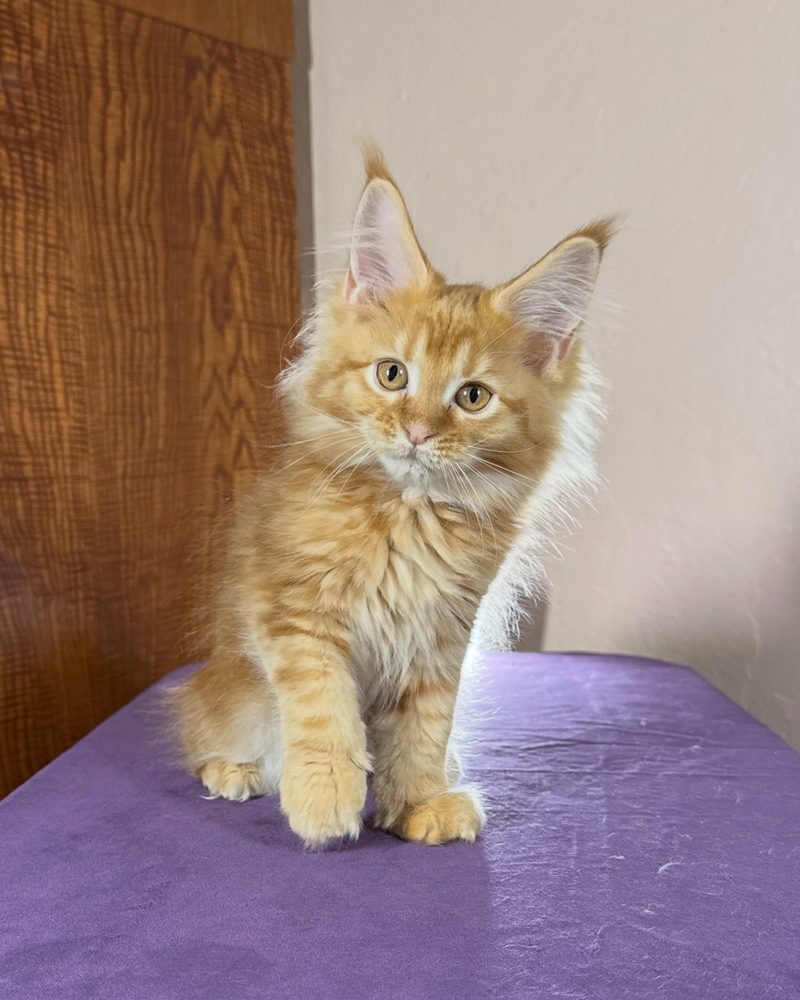
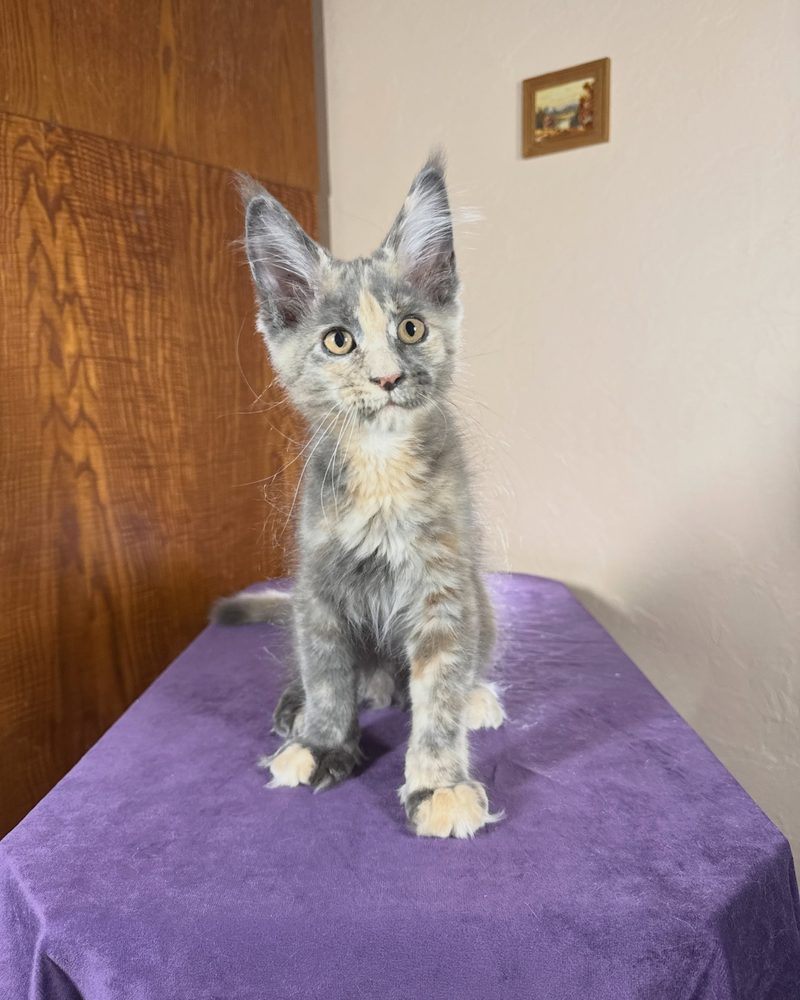
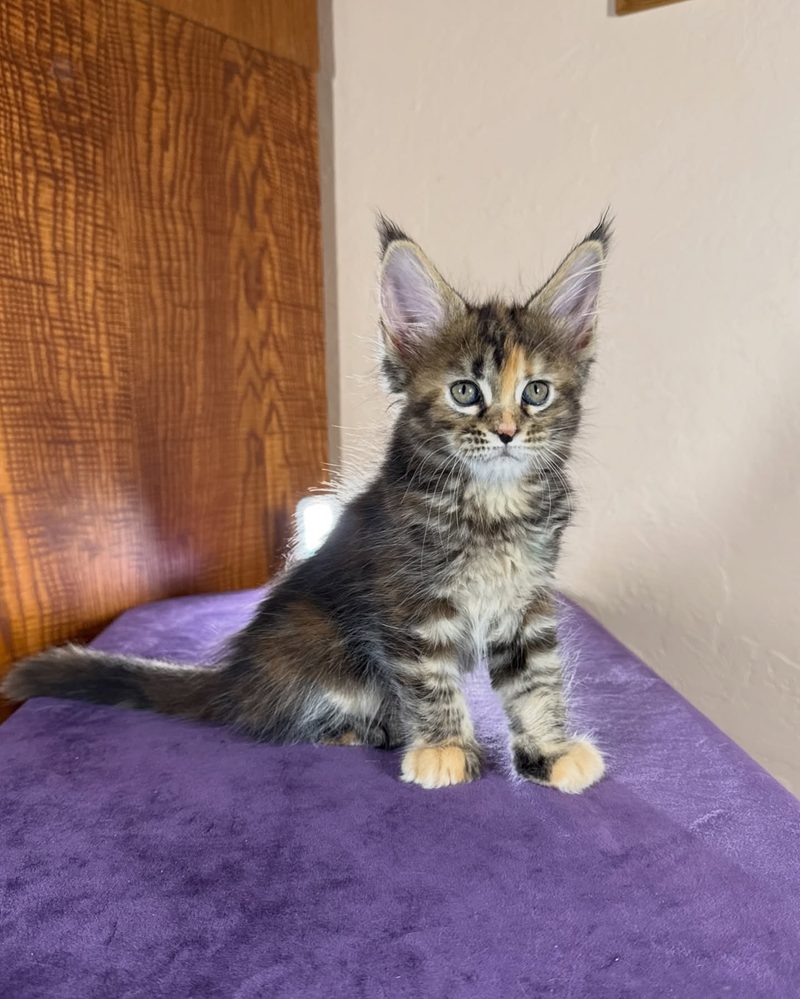
- Ears. Large, wide at the base and set high, often with lynx tips (tufts of hair at the points) and long ear furnishings inside.
- Paws. Big and round, often compared to snowshoes, with tufts of fur between the toes.
- Ruff. A frill of longer fur around the neck and chest, usually heavier in males.
- Tail. Long, thick at the base and bushy, at least as long as the back.
- Coat. Shaggy and uneven: short on the shoulders, longer down the back and sides, and longest on the belly and the britches of the hind legs. Silky and heavy rather than cottony.
- Eyes. Large, slightly oval and set wide apart.
- Head and muzzle. A square, boxy muzzle, high cheekbones and a firm chin, with a gentle dip in the profile.
- Body. Long, rectangular and muscular, with a broad chest and sturdy legs.
Color is no help. Maine Coons come in many colors and patterns; see Maine Coon colors.
How Do Maine Coons Behave?
Behavior is a weaker clue than looks, since plenty of ordinary cats share these traits, but Maine Coons are known for:
- Chirps and trills. Many make soft, bird-like chirps and trills more often than loud meows.
- Interest in water. Pawing at the water bowl, playing with a dripping faucet or following you into the bathroom.
- Sociability. Friendly, easygoing and keen to be where their people are, often following them from room to room.
- A long kittenhood. They often stay playful well into adulthood.
More in Maine Coon behavior and Maine Coon personality.
Is My Cat Part Maine Coon?
Go through your cat with this table. The more rows that match, the more Maine Coon type it has, though even a full score is not proof.
| Feature | Typical Maine Coon | Ask yourself |
|---|---|---|
| Size | Large and long; males 13 to 18 lb, females 8 to 12 lb | Is it clearly bigger than most cats? |
| Growth | Keeps growing until 3 to 5 years | Was it still filling out after age two? |
| Ears | Large and tall, with lynx tips and furnishings | Are there tufts on the tips and inside? |
| Paws | Big and round, with toe tufts | Does fur sprout between the toes? |
| Ruff | A thick frill at the neck and chest | Does it have a mane? |
| Coat | Shaggy and silky; short on the shoulders, long on the belly and britches | Is the coat longer underneath than on top? |
| Tail | Long and bushy | Does it reach the shoulders when laid along the back? |
| Muzzle | Square and boxy | Is the muzzle square rather than pointed? |
| Voice | Chirps and trills | Does it chirp more than it meows? |
How Is a Maine Coon Different from a Norwegian Forest Cat or Siberian?
These three large, long-haired breeds are easily confused, and a domestic long-haired cat can look like any of them. The differences are tendencies, so an individual cat may not fit neatly:
| Trait | Maine Coon | Norwegian Forest Cat | Siberian | Domestic long hair |
|---|---|---|---|---|
| Head | Square muzzle, gentle dip in profile | Triangular, straight profile from brow to nose | Rounded, with a softer, rounder muzzle | Varies |
| Body | Long and rectangular | Solid, hind legs a little longer than front | Rounded, barrel-like and heavy | Usually medium-sized |
| Coat | Shaggy, uneven and silky | Dense double coat with a full bib | Very thick and dense | Any length or texture |
| Tail | Very long | Long and bushy | Thick, usually a little shorter | Varies |
| Origin | Maine, USA | Norway | Russia | Random-bred, no pedigree |
The quickest single tell is often the head: the square Maine Coon muzzle, against the straight-nosed triangle of a Norwegian Forest Cat and the softer, rounder face of a Siberian.
How Do You Identify a Maine Coon Kitten?
It is harder with kittens than with adults, because many breed features are not developed yet. Look for:
- Big ears that look too large for the head, often with tufts already showing at the tips.
- Large paws and thick legs, a sign of the size to come.
- A long, thick tail for a kitten its size.
- Slow, steady growth. A typical Maine Coon kitten weighs 2 to 4 pounds at ten weeks and 7 to 11 pounds at six months, and is still growing well after its first birthday. Compare yours with the Maine Coon kitten growth stages.
- A coat that is shaggier on the belly and legs, with the ruff and britches starting to come in.
A long-haired kitten with big paws can still grow into an average-sized house cat. If you are buying a kitten as a Maine Coon, the papers matter more than any of these signs.
What Are Maine Coon Cats Mixed With?
A purebred Maine Coon is not a mix of anything. It is a natural breed that developed among the farm and ship cats of New England, and Maine made it the official state cat in 1985. Its exact origins are unknown; the most likely explanation is that long-haired cats brought over by sailors and settlers bred with local short-haired cats. The old story that Maine Coons are part raccoon is a myth, since cats and raccoons cannot interbreed. More on the breed's history in what is a Maine Coon cat.
A "Maine Coon mix" is a cat with some Maine Coon ancestry, for example one purebred parent and one domestic cat. In practice the label is often given to any large, fluffy cat in a shelter based on looks alone. A mix may inherit the size, the tufts or the chirping, or none of them. It can make a wonderful pet; it just is not a purebred Maine Coon.
Why Does It Matter If a Cat Is a Real Maine Coon?
For a cat you already love, it hardly matters. When you are buying a kitten, it matters a great deal. Maine Coons are one of the most copied listings online. Kittens sold as Maine Coons without papers are often mixed or random-bred, and some ads are scams for kittens that do not exist.
- Ask which registry. A breeder should name it and be able to show the parents' registration.
- Check the breeder yourself on the registry's own website, not through a link the seller sends.
- Know when papers arrive. Pet kittens are often sold on a spay or neuter agreement, with papers sent afterward.
- Talk to the breeder by phone or video, with the kitten in view, before you pay anything.
A purebred kitten comes with registration papers. Kats Kits kittens are registered, and the papers are sent once your vet confirms the kitten has been spayed or neutered. A Maine Coon kitten from Kats Kits is $700. See the available Maine Coon kittens, or read finding Maine Coon kittens near you for more ways to avoid scams.
Quick Answers
Is my cat part Maine Coon?
It may be if it has several of the signs above, but without papers or a DNA test there is no way to know. Many large, fluffy cats are simply domestic long hairs.
Can a DNA test prove my cat is a Maine Coon?
Not on its own. A consumer DNA test estimates which breeds your cat resembles; only pedigree papers prove a purebred.
Do all Maine Coons have ear tufts?
Most have some, but the size of the lynx tips varies a lot, and many cats that are not Maine Coons have small tufts too.
Are all big fluffy cats Maine Coons?
No. Domestic long-haired cats, Norwegian Forest Cats, Siberians and many mixes can all be big and fluffy.
Are Maine Coons part raccoon?
No. It is an old folk tale, probably inspired by the bushy tail and brown tabby coat, but cats and raccoons cannot interbreed.
How big is a Maine Coon kitten at 10 weeks?
Usually 2 to 4 pounds. Size alone at this age does not prove a kitten is a Maine Coon.
Is my kitten a Maine Coon?
If it came from a registered breeder with papers, yes. If not, big tufted ears, large paws and a long, thick tail are good signs, but many fluffy kittens grow into ordinary house cats, so watch how it grows over its first year or two.