The Maine Coon guide · Kats Kits
Are Maine Coons Friendly?
Yes. Maine Coons are known as the gentle giants of the cat world: big, easy-going cats that are usually friendly with their family, relaxed with visitors and good with children and other pets. They like to be involved in whatever their people are doing, and they stay playful well into adulthood.
They are not all lap cats, though, and every cat is an individual. How a kitten is raised matters as much as its breed. If you are new to the breed, start with what a Maine Coon is.
What Is a Maine Coon's Temperament Like?
The typical Maine Coon is calm, confident and sociable. These are the traits owners and breeders describe again and again:
- Gentle. For all their size, most Maine Coons are soft-mannered and patient, and slow to swat or bite.
- Sociable. They like company, and many come to meet visitors rather than hide under the bed.
- Involved. Many follow their people from room to room to see what is going on, whether that is unpacking groceries, folding laundry or working at a desk.
- Easy-going. Household noise, new people and changes of routine usually bother them less than they bother more sensitive cats.
- Dog-like. Many learn their name, come when called, play fetch and can be trained to walk on a harness.
- Chatty, not loud. Chirps, trills and soft chattering rather than demanding meows, and most are much quieter than famously vocal breeds such as the Siamese. The sounds are covered in Maine Coon behavior.
Are Maine Coons Affectionate and Cuddly?
Affectionate, very. Most Maine Coons are openly loving with their family: they come to greet you, rub against your legs, bump their head against your hand and chirp for attention. Constant lap cats, often not. A typical Maine Coon wants to be near you: on the couch beside you, at the end of the bed or on the desk next to your keyboard. Some are true lap cats and settle on you whenever you sit down, but many prefer to lean against you rather than climb on, and a 15 pound cat on your lap is a commitment anyway (see how big Maine Coons get).
Many Maine Coons also dislike being picked up and held for long. That is usually about comfort rather than affection, as a big cat may feel insecure with its back legs dangling. Support the back end, keep cuddles short and let the cat come to you, and it will usually choose to stay close.
Are Maine Coons Good With Children?
Usually, yes. Their patience and size make them a good match for families. A Maine Coon is sturdy enough to put up with some noise and fuss, and is less easily hurt by clumsy handling than a small, delicate cat. Most enjoy children who play with them.
The rules are the same as for any cat. Teach children to stroke gently, to leave a sleeping or eating cat alone, and to pick the cat up only with an adult's help, supporting its back end, since a grown Maine Coon is heavy for a child. Give the cat a high perch or a quiet room to retreat to, and supervise toddlers.
Do Maine Coons Get Along With Dogs and Other Cats?
Generally well. Maine Coons tend to be confident rather than nervous, so they often live happily with other cats and with cat-friendly dogs, and many enjoy the company.
The introduction matters more than the breed: separate rooms first, then scent swapping and short, supervised meetings over days or weeks. Are Maine Coons good with dogs? goes through it step by step. Small pets such as birds and hamsters are a different matter: a Maine Coon is still a hunter, and they should be kept safely apart.
Are Maine Coons Playful and Smart?
Very. Maine Coons mature slowly and keep a kitten's love of play for years. They enjoy wand toys, chasing balls down a hallway, puzzle feeders and anything they can bat into water. Many learn tricks with treats or clicker training, and some work out how to open cabinets and lever door handles.
That intelligence needs an outlet. Two short play sessions a day, a tall cat tree and toys rotated so they stay interesting will keep a young Maine Coon busy. A bored one will find its own entertainment, which is usually less welcome.
Are Maine Coon Cats Aggressive or Dangerous?
No. Aggression is not a breed trait, and the Maine Coon's reputation is the opposite: their size can make them look fearsome in photos, but they are known as one of the gentlest breeds, not a mean or dangerous one. When a Maine Coon does hiss, swat or bite, there is usually a reason:
- Fear. A cat that was handled little as a kitten may be wary of people, especially strangers.
- Pain. A cat that suddenly turns grumpy, or snaps when touched, may be hurting. Joint problems, dental pain and illness are all possible, so see your vet; Maine Coon lifespan covers the breed's health.
- Play that goes too far. A kitten allowed to play with bare hands grows into a big cat that grabs and bites in play. Use toys, not fingers.
- Redirected aggression. A cat that sees another cat through the window may lash out at whoever is nearest.
- Stress. A new pet, a house move or a change of routine can make any cat defensive for a while.
Because Maine Coons are big, a swat or bite does more damage than a small cat's, so it is worth dealing with early. A bite that breaks the skin should be cleaned and shown to a doctor, as cat bites can become infected. Your vet, or a qualified feline behaviorist, can help if the behavior does not settle.
Should I Get a Male or Female Maine Coon?
Choose the kitten first and the sex second. Neither sex is reliably friendlier, and both make loving pets. These are the differences owners and breeders usually describe:
| Male | Female | |
|---|---|---|
| Grown weight | Usually 13 to 18 lb | Usually 8 to 12 lb |
| Build | Broader head, heavier bone, bigger ruff | More compact and lighter to lift |
| Often described as | Goofy, laid-back and openly affectionate | A little more independent: just as loving, but on her own terms |
| Day-to-day costs | Eats more, needs the biggest litter box and carrier | Slightly less of both |
Before they are fixed, males may spray urine to mark territory and females come into heat, calling loudly and restlessly. Spaying or neutering evens out most of that, and Kats Kits kittens are spayed or neutered before 9 months. If you want the biggest possible cat, a male is the safer bet. Otherwise, tell the breeder about your home and ask which kitten's personality suits it: that tells you more than its sex.
How Does Upbringing Shape a Maine Coon's Personality?
A great deal. Kittens are most open to new experiences in roughly their first two months, and what they meet then shapes how they react to the world as adults. A kitten handled gently every day and raised around household sounds, visitors and ordinary family life grows up expecting people to be good company. One raised with little handling, in a shed or a cage, can grow into a shy or nervous cat, whatever its breed. That is why it is worth asking any breeder where and how the kittens are raised.
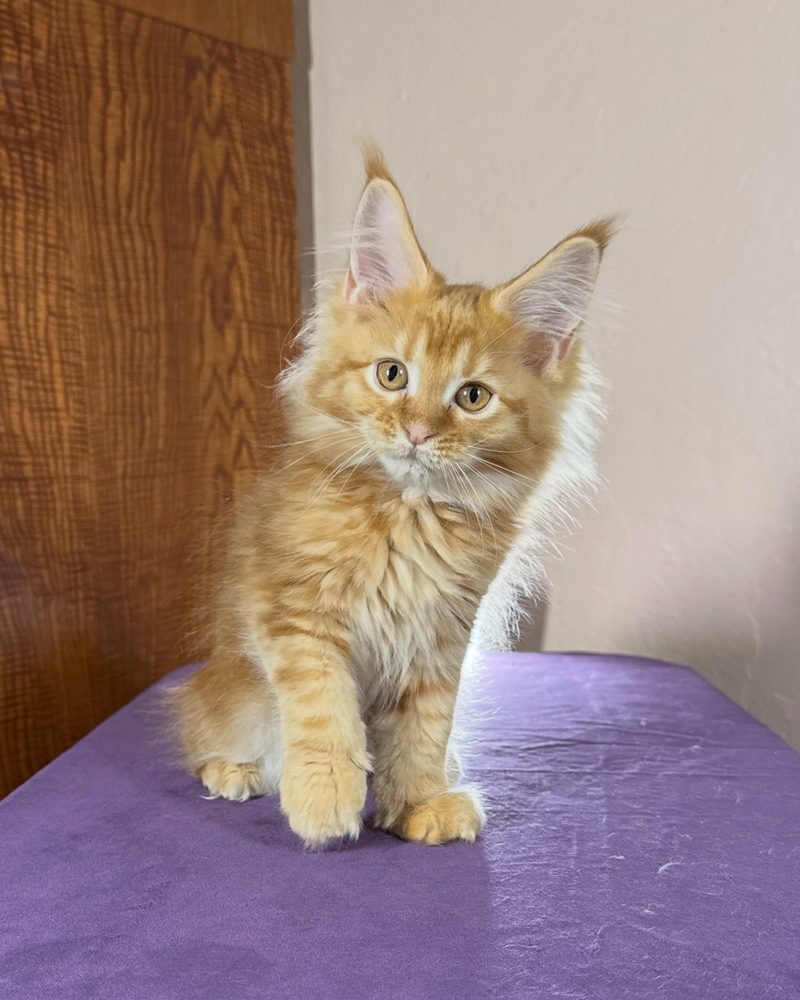
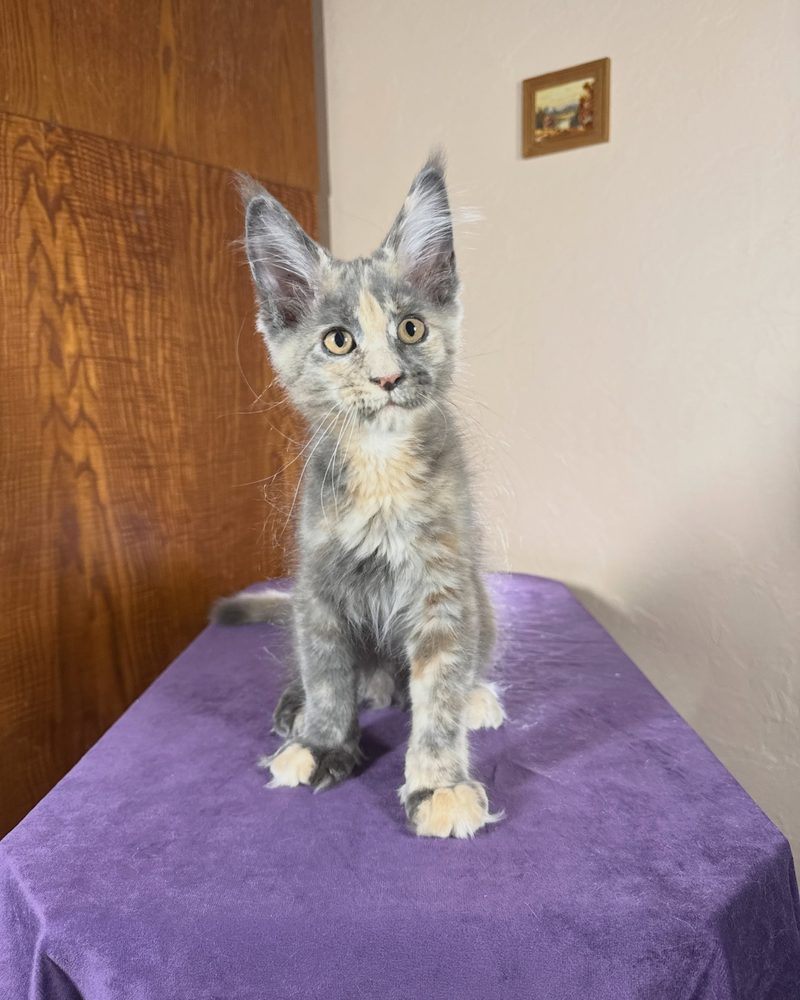
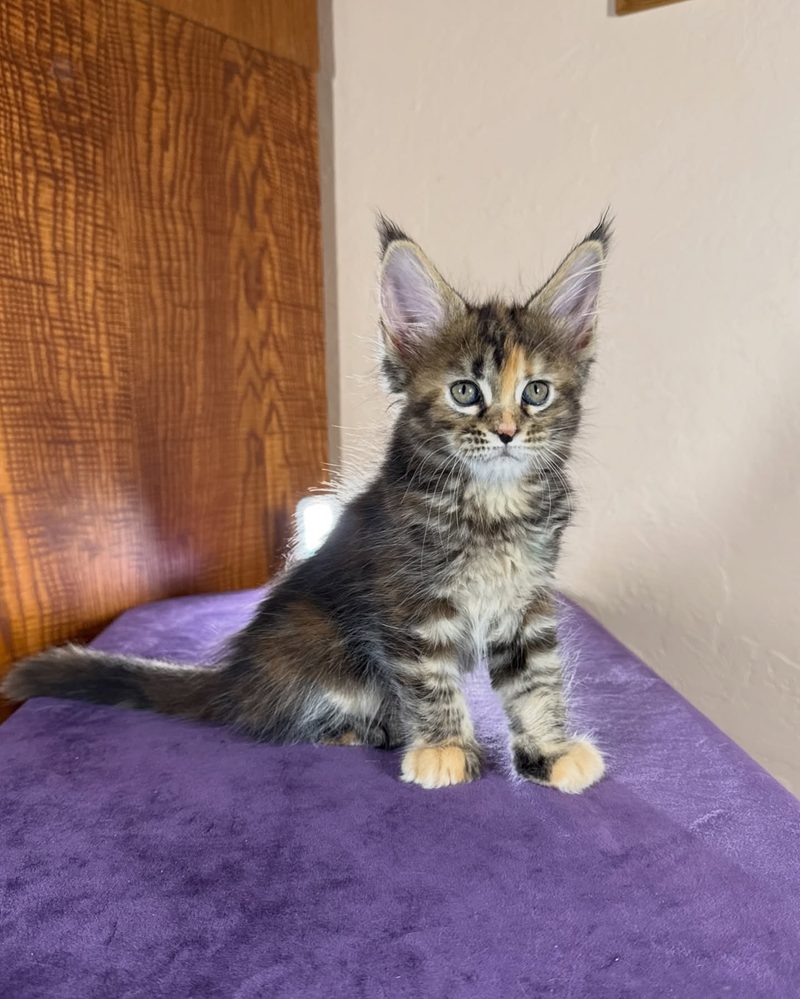
At Kats Kits, the kittens are raised in Kat's home in Farmington and handled every day until they go home at 10 weeks, so they leave used to family life. You can see the kittens ready now on the available kittens page.
Are Maine Coons High Maintenance?
Not especially, and their friendly, forgiving nature makes them a good first cat. The extra work, compared with an average cat, comes from the coat, the size and the need for company:
- Grooming. Brushing two or three times a week, more during the spring and fall sheds. See shedding and grooming.
- Size. An extra-large litter box, a tall, heavy cat tree, and food and vet bills scaled to a big cat. How much a Maine Coon costs sets out the numbers.
- Company and play. A sociable cat that wants people around and a couple of play sessions a day.
Apartments are fine. A Maine Coon does not need a yard; it needs vertical space, a window to watch from and someone to play with. The full routine is in how to care for a Maine Coon.
How Long Can You Leave a Maine Coon Alone?
A healthy adult can usually manage up to about a day on its own, such as a long working day or a single night away, as long as it has fresh water, enough food and a clean litter box. For anything longer, arrange a pet sitter or a friend to visit at least once a day to feed, scoop the box and check that the cat is well. An automatic feeder helps, but it is no substitute for someone looking in.
Kittens need more company. A young kitten eats several small meals a day and gets into everything, so plan to be home a lot for its first weeks, and leave it in a safe, kitten-proofed room when you go out. And coping is not the same as thriving: a Maine Coon left alone most days will be happier with toys, a window perch and possibly a second cat for company.
Quick Answers
Are Maine Coons good pets?
For most homes, yes. They are friendly, adaptable and good with families, as long as you are ready for the brushing, the size and the hair.
Are Maine Coon cats friendly with strangers?
Usually. Most are curious and come to meet visitors rather than hiding, though a shyer cat may watch from a distance first.
Do Maine Coons bite?
Rarely, as adults. Kittens nip in play, so use toys rather than hands, and see your vet if a grown cat starts biting out of character.
Do Maine Coons get attached to one person?
Some bond most closely with one person, but most are friendly and affectionate with the whole household.
Do Maine Coons like to sleep with their owners?
Many do, often at the foot of the bed or pressed against your legs. Others prefer a cat tree or a sunny window, and both are normal.
Are Maine Coon cats mean?
Not by nature. A Maine Coon that seems mean is usually frightened, in pain or was allowed to play rough as a kitten, and a vet check is the first step if a friendly cat changes.
Can a Maine Coon kill a human?
No. A domestic cat, even a big Maine Coon, is not a danger to a person's life. Like any cat, though, it can scratch or bite if it is frightened or hurt, so give it space when it is upset.